Employee timetable
You can specify a timetable or a work timetable for an employee. This can be a default timetable or working hours/days that are specific to the employee.
|
Content |
Description
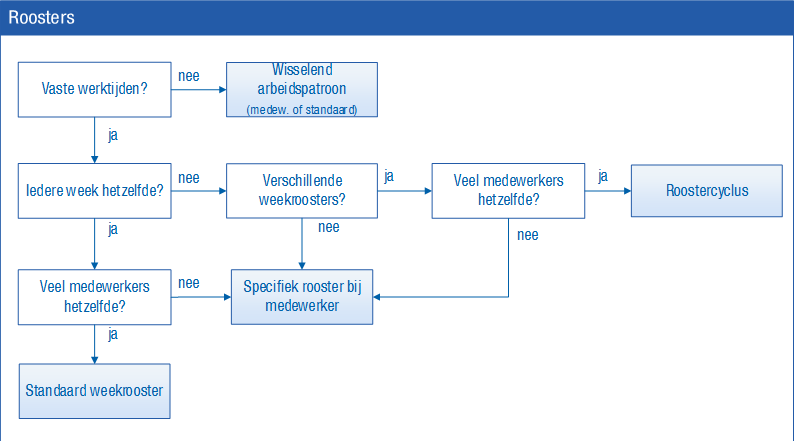
The CLA/term of employment of the employees can contain multiple default timetables. This can be a default weekly timetable or a default timetable for a variable work pattern. The important thing is that the timetables apply to multiple employees. When you link a default timetable to an employee, that employee has fully configured timetable. If none of the default timetables is the correct timetable, you can enter a specific timetable for the employee.
A variable work pattern means that an employee does not have fixed working hours and/or working days.
If an employee has a work timetable (for example in the case of shift work), you link a timetable cycle with different week timetables to the employee.
Employee working hours |
Add timetable |
Configuration |
|---|---|---|
The same fixed working hours per week. |
You link a default timetable to these employees. |
Default timetables in the CLA/term of employment |
Deviating fixed working hours/days per week (for example support staff that starts earlier or part-time workers). |
You enter the working hours per week. |
None. |
Variable work pattern per week, but a fixed number of hours (including zero hour contracts). |
You link a default timetable to these employees. |
Default timetables in the CLA/term of employment |
Variable work pattern. The employee does not have fixed working hours. |
If possible, you enter the number of days and hours for the employee. |
None |
Working hours based on a work timetable. Each week the employee has a different timetable, for example when working in shifts. |
You link a work timetable. |
Timetable cycle |
 More information about applying the timetable.
Preparation
Procedure
- Record a timetable change in InSite
- Weekly timetable
- Work timetable
- Add deviations from a timetable
- Timetable days and worked contract days
- View the timetable and public holidays in Profit Calendar