CLA
A CLA in Profit contains a large number of issues regarding the payroll configuration and terms of employment. With regard to the Payroll configuration this may include wage components, calculation bases and parameters. This data is especially important for the calculation of wages in Profit Payroll. With regard to the terms of employment this may include the settings for leave and absence. The terms of employment are important for both Profit Payroll and Profit HR.
|
Content |
Description
The CLAs form the highest configuration level in Profit: the settings that you record in a CLA apply to all linked employers and employees. Per employer, you specify the CLAs that can apply to its employees. An employee can have one (current) CLA.
As an example, in the diagram you can see two CLAs and three employers:
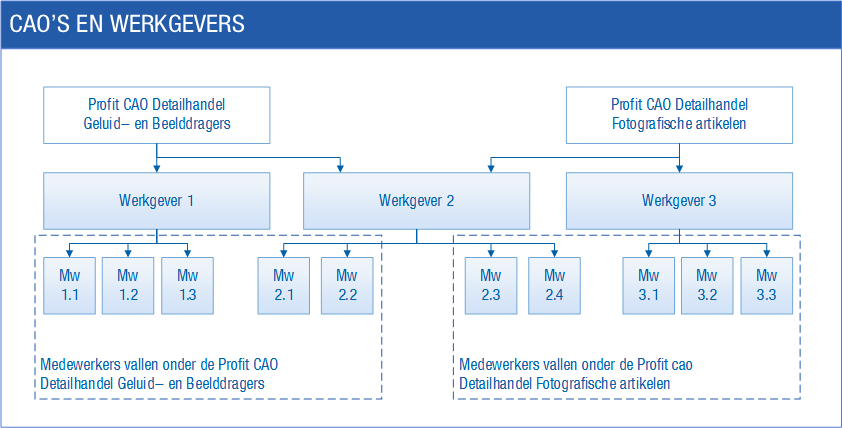
In this structure you would record data at the highest possible level. If you implement a change in a CLA, it also applies to the lower levels (employers and employees). You can deviate from the CLA level settings at lower levels.
Payroll configuration and terms of employment
A CLA always contains a default payroll configuration and one or more terms of employment. The default payroll configuration of Profit CLAs is maintained and supplied by AFAS. A term of employment is a collection which contains predominantly HR-related items such as employment types, leave types and default timetables. Terms of employment are not supplied by AFAS. You have to configure them yourself.
For most organisations, one term of employment is sufficient because items such as leave entitlement, absence rules and the working week are the same for all employees.
If deviating terms of employment apply for various groups of employees, you add extra terms of employment within the CLA. In this situation, you link the employee to the correct CLA and to the applicable term of employment.
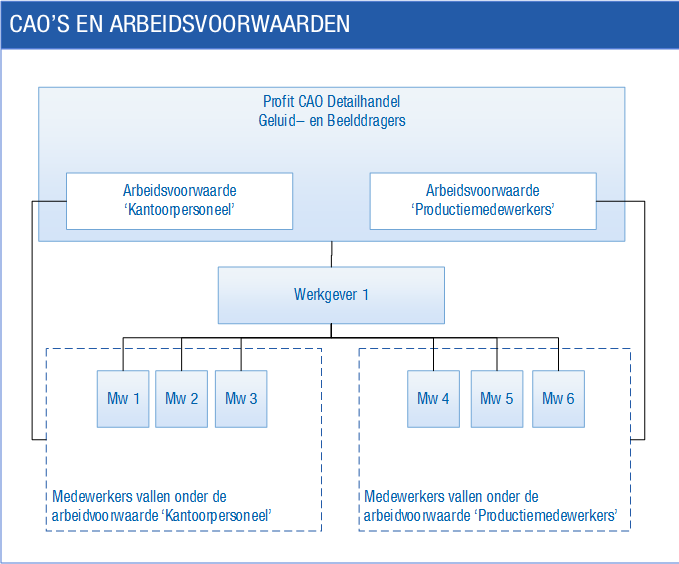
Other issues:
 Which CLA for a specific employee type?
Procedure
- CLA Update
- Add a CLA
- Add a term
- Set up decimal places
- Delete or block a CLA
- Check the CLA version
- Term of employment